The short answer
- 01Do not pick one. Build your cart, quote and order logic once as your own services, and treat ACP and UCP as thin adapters. Both specifications are open source and both are still changing.
- 02For ChatGPT, discovery comes first. OpenAI stepped back from native Instant Checkout in March 2026. ChatGPT now sends most shoppers to the retailer’s own site or app, so a complete, live product feed matters more today than an ACP checkout endpoint.
- 03For Google, checkout is coming to the UK later. UCP checkout launched in the US and is expanding to Canada and Australia before the UK. UK retailers have time to prepare product data and Merchant Center before it arrives.
- 04The deciding factor is your platform. Shopify merchants get much of both for free. Retailers on custom or enterprise platforms carry the integration work and should sequence it.
This article goes deep on one decision from my blueprint for agentic commerce architecture. If you are new to the topic, start there.
What ACP and UCP actually are
The Agentic Commerce Protocol (ACP) is an open standard released by OpenAI and Stripe in September 2025 under the Apache 2.0 licence. Stripe’s documentation now lists Meta alongside them as a creator. It defines how an AI agent reads a merchant’s product feed, manages a cart, creates and completes a checkout session, passes a payment token and, through OAuth 2.0, acts on a buyer’s behalf with the merchant. The latest published specification at the time of writing is dated 17 April 2026.
The Universal Commerce Protocol (UCP) is an open standard Google announced in January 2026 with Shopify, Etsy, Wayfair, Target and Walmart, also under Apache 2.0. A merchant publishes a manifest at /.well-known/ucp that declares its capabilities: checkout, identity linking, order and payment token exchange, with extensions such as discounts and fulfilment. Capabilities can be offered over REST, the Model Context Protocol (MCP) or agent-to-agent (A2A) transports. In April 2026 Amazon, Meta, Microsoft, Salesforce and Stripe joined its tech council.
Both keep the retailer as merchant of record. Both use tokenised payment rather than raw card details. Both can be reached over MCP. On paper they look like competitors; in practice they are front doors to two very different shopping surfaces.
What happened to ChatGPT Instant Checkout
Any honest comparison has to start with the most important event in this market so far. ChatGPT Instant Checkout launched on 29 September 2025, powered by ACP, with Etsy sellers first and over a million Shopify merchants announced as “coming soon”. Six months later OpenAI changed course.
Exhibit 1
From launch to reset: ACP, Instant Checkout and UCP, September 2025 to May 2026
OpenAI told TechCrunch in March 2026 that “the initial version of Instant Checkout did not offer the level of flexibility that we aspire to provide.” ChatGPT shifted towards product discovery (side-by-side comparisons, images, prices and reviews) and sends shoppers to the retailer’s own checkout or to apps inside ChatGPT. ACP continues to power how participating merchants’ product data reaches ChatGPT.
Trade press reported that only a handful of Shopify merchants had actually gone live before the change. I would treat those figures with caution, but the direction is not in doubt, and it holds a lesson for anyone planning a build: the protocol was not the bottleneck. Operations were. Live prices, accurate stock, fraud controls, returns and customer service all have to work when an order arrives from somewhere other than your own website.
ACP and UCP side by side
| Agentic Commerce Protocol (ACP) | Universal Commerce Protocol (UCP) | |
|---|---|---|
| Origin | OpenAI and Stripe, September 2025; Meta now listed as a creator | Google with major retailers, January 2026; tech council includes Amazon, Meta, Microsoft, Salesforce, Stripe |
| Licence | Apache 2.0 | Apache 2.0 |
| Main surface today | ChatGPT (discovery-led since March 2026), apps in ChatGPT | Google AI Mode, Gemini, Universal Cart, YouTube, shopping ads |
| Discovery | Product feed pushed to the agent platform | /.well-known/ucp manifest plus Merchant Center product data |
| Checkout | Checkout sessions: create, update, complete | Checkout capability, extended by discount and fulfilment |
| Payment | Delegated payment through tokens, Stripe Shared Payment Token first | Payment handlers (for instance Google Pay) and payment token exchange; compatible with AP2 mandates |
| Customer identity | Delegated authentication with OAuth 2.0 | Identity linking with OAuth 2.0 |
| Transports | REST or MCP | REST, MCP or A2A |
| Merchant of record | Retailer | Retailer |
| UK checkout status | Native ChatGPT checkout deprioritised; discovery and app routes active | US live; Canada and Australia next; UK announced for later |
Status reflects public announcements up to October 2026. Both specifications are versioned; check the current release before building.
Where they genuinely differ
- 01Discovery model. ACP is feed-first: you push structured product data to the platform. UCP is declaration-first: you publish what you can do, and Google’s surfaces combine it with the product data you already send to Merchant Center.
- 02Breadth. UCP is designed as a general framework of capabilities with extensions, and Google has said it will extend it to hotel booking and food delivery. ACP is narrower and closer to a checkout contract.
- 03Payments. ACP grew up with Stripe’s token; UCP declares payment handlers and points to AP2 mandates for delegated authority. Visa’s Intelligent Commerce Connect accepts payments started through both.
- 04Commercial gravity. Google already holds most UK retailers’ product data through Merchant Center and shopping ads. That makes UCP the lower-friction route for many, once checkout reaches the UK.
Exhibit 2
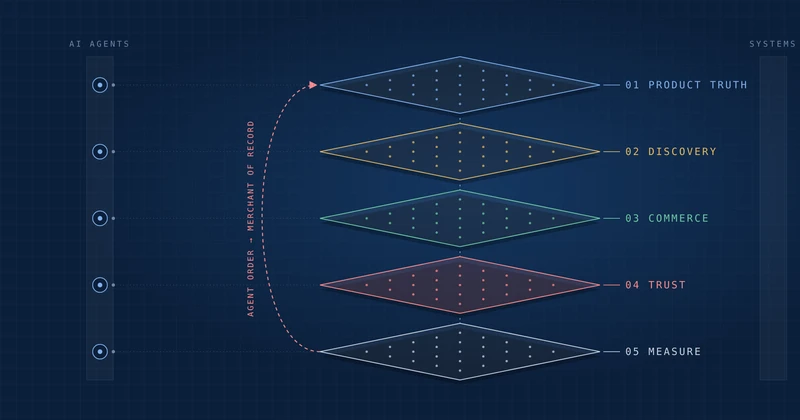
Build once, adapt twice: how one set of commerce services maps to both protocols
Which to build first: a decision guide
The right sequence depends less on the protocols than on your platform, your channels and where your customers already shop. These are the four situations I see most often.
| Your situation | First move | Why |
|---|---|---|
| Shopify or a platform with native connectors | Switch on the platform’s agent channels; spend your effort on product data quality | Shopify connects merchants to ChatGPT shopping through its catalogue, and in September 2026 Google enrolled eligible US Shopify merchants in native checkout in AI Mode and Gemini by default; much of the integration is done for you |
| Custom or enterprise platform, strong Google Shopping business | Prepare for UCP: Merchant Center data, a cart and quote service, a manifest in a test environment | Your product data already flows to Google; UK checkout is coming, and the services are reusable for everything else |
| Custom platform, brand with high ChatGPT visibility | Apply for a direct product feed to ChatGPT; send traffic to your own checkout; build the ACP adapter later | ChatGPT is discovery-led; feed quality drives recommendations today, native checkout does not |
| Marketplace seller | Follow the marketplace’s agent programme; invest in listing data | The marketplace, not you, will usually be the merchant integrating the protocol |
What the integration actually involves
For a retailer on its own platform, the protocol adapter is the small part. This is how I would estimate the work for a mid-sized UK retailer, assuming the core commerce services do not yet exist as APIs.
| Workstream | Needed for | Typical effort |
|---|---|---|
| Product data contract and live offer service | Both, and every other channel | Largest share; ongoing ownership |
| Cart, firm quote and order services as APIs | Both | Large; often the main build |
| Payment provider support for agent tokens | Both | Small to medium; mostly configuration |
| Account linking with OAuth 2.0 | Both, optional at first | Medium |
| ACP adapter and feed | ChatGPT and other ACP platforms | Small once services exist |
| UCP manifest and adapter | Google surfaces | Small once services exist |
One detail catches teams out. When checkout happens on the agent’s surface, your website’s analytics tags do not run. Shopify’s notes on Google’s native checkout, for instance, say client-side pixels do not fire and only server-to-server events are sent. Plan server-side order attribution before the first agent order arrives, or the channel will look smaller than it is.
Efforts are relative, not quotes. The point of the table is the shape: if the services exist, supporting a second protocol is a modest extension. If they do not, choosing between ACP and UCP is the wrong question.
The protocol was never the bottleneck. Live prices, stock, fraud and returns were.
Abubakr Akhtar
What this means for UK retailers in the next 12 months
- 01Now: make product data complete and current, and make sure your feeds to Google and ChatGPT are accurate. This pays off whatever happens to checkout.
- 02Next two quarters: expose cart, firm quote and order as internal APIs with clear reason codes, and confirm your payment provider’s plans for agent tokens.
- 03When UCP checkout reaches the UK: switch on the UCP adapter, starting with categories where Google already drives most of your sales.
- 04Keep watching ChatGPT: OpenAI has said apps are its route for in-chat purchases. If your customers shop there, an app or ACP adapter can follow quickly on the same services.
The payments behind both protocols are covered in agentic payments explained, and verifying which agent is calling is covered in Web Bot Auth and the Trusted Agent Protocol. Being recommended in the first place is the subject of generative engine optimisation for ecommerce.
About the author
Abubakr Akhtar
Enterprise business development & partnerships
Abubakr Akhtar is a technology expert who has worked with global companies on martech and solutions.
LinkedInFrequently asked questions
OpenAI deprioritised Instant Checkout as a standalone feature in March 2026. ChatGPT now focuses on product discovery and sends shoppers to the retailer’s checkout or to merchant apps inside ChatGPT. The Agentic Commerce Protocol continues to supply product data from participating merchants.
Eventually, probably. But you should not build two integrations. Build your cart, quote and order services once and add a thin adapter for each protocol when the surface it serves matters to your customers.
Not yet, as of October 2026. Google said in May 2026 that UCP checkout would expand to Canada and Australia, then the UK.
Yes. Both are published under the Apache 2.0 licence, with public specifications and repositories.
Ready to put AI to work in your business? Let's talk.
Book a free 30-minute introduction call with our team. No obligation.
- Stripe: Instant Checkout in ChatGPT and the Agentic Commerce Protocol (September 2025)
- Stripe Docs: Agentic Commerce Protocol
- Agentic Commerce Protocol: specification site
- TechCrunch: OpenAI’s plans to make ChatGPT more like Amazon aren’t going so well (24 March 2026)
- Universal Commerce Protocol: GitHub repository
- Google for Developers: Under the hood of the Universal Commerce Protocol
- Google: UCP features and AI tools for retailers (Google Marketing Live, May 2026)
- Search Engine Journal: Google announces Universal Cart at I/O (May 2026)
- OpenAI Help Center: shopping in ChatGPT
- TechWyse: Google enrols eligible Shopify merchants in native AI checkout (September 2026)